

Iran’s Self-Rescue and the Moral Test for a Silent West
When calls for rescue come from people oppressed by regimes that don’t align with today’s topsy-turvy worldview, why is the response so often silence?
Do we truly stand with the oppressed - or only with those whose suffering flatters the approved ideology of the moment? I’m not offering answers today. Only a question that should trouble any citizen of a free nation:
If meddling in free speech is now acceptable, what else becomes fair game?
When human beings are treated like subjects and serfs, why is it suddenly controversial to object? Why are we expected to tolerate laws designed to shrink our liberties and lock our tongues behind bars?
That’s why my thoughts landed on Ross Perot - a billionaire outsider who refused to wait for governments, diplomats, or armies. In 1979, as revolutionary Tehran shook itself to pieces, Perot mounted a private rescue mission to save two employees because he believed duty demanded it.
Fast-forward to today. Iran’s nationwide protests, now entering their third week after erupting on December 28, 2025, carry echoes of that moment.
Only this time, there is no Ross Perot coming over the horizon.
Instead, ordinary Iranians - shopkeepers, students, factory workers - have decided the price of silence is higher than the cost of speaking out.
Back in 1979, the Shah fell, Khomeini rose, and Perot’s daring raid became legend.....
Ross Perot was born on June 27, 1930, in Texarkana, Texas. Growing up during the Great Depression, Perot learned the value of hard work and entrepreneurship from a young age.
By the early 1970s, Perot had already made a name for himself working in computer data processing. From 1957 to 1962, Perot worked for IBM.
Following his time with IBM, he formed his own company, Electronic Data Systems. His leadership and entrepreneurial skills transformed EDS into a major success. However, in 1978, Perot faced a crisis that would test his mettle in an entirely different arena.
Two of Perot's employees, Paul Chiapparone and Bill Gaylord, were imprisoned in Iran. They had been accused of corruption in connection with a contract EDS had secured with the Iranian government.
In December 1978, Perot had stopped EDS operations in Iran because Iran hadn’t paid the $5 million that it owed. Things were unstable in Iran anyway at the time. Perot said that within 12 hours of his decision to withdraw his employees, Iran took two of his employee's passports away and held them hostage. The Iranian government said it would free his two employees if EDS renegotiated its contract. Their ransom was set for $12.7 million and the money had to be paid through Iranian banks.
What a lot of people did not know was that Perot was appointed by Secretary of the Navy John Warner to report on the conditions of Americans in Vietnamese and Laotian POW camps for four years until the prisoners were released in 1972 at the end of the Vietnam War.
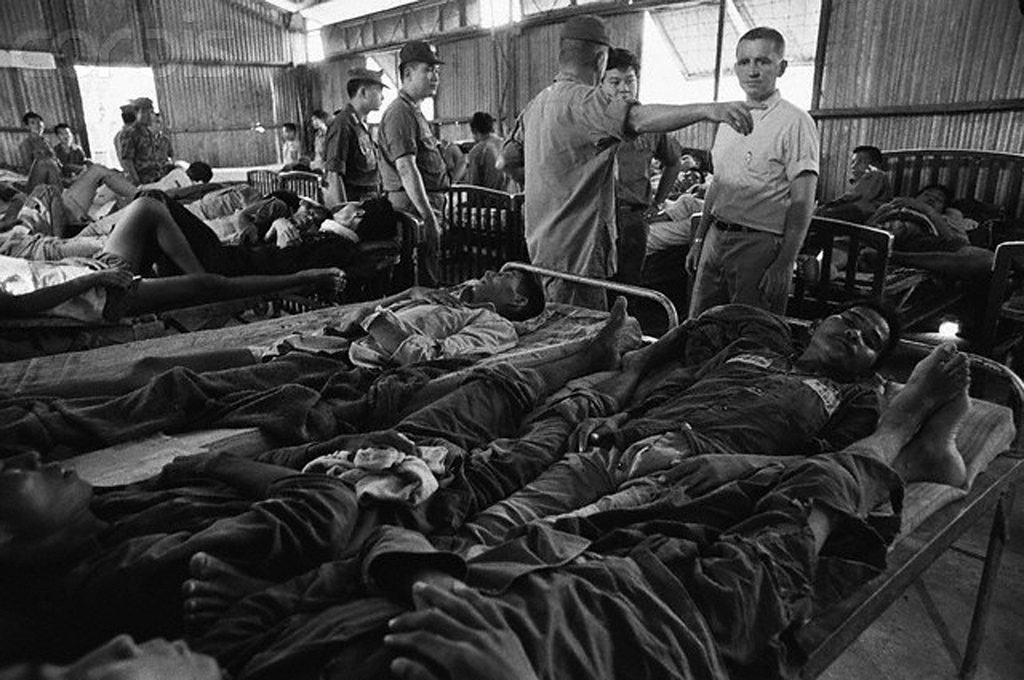
He had a first-hand knowledge of what it was to see the POW conditions. He made it his mission to save his employees.
The situation worsened as Iran was descending into chaos during the Islamic Revolution, with the Shah's regime crumbling and Ayatollah Khomeini gaining influence.
Perot later wrote that the American government wasn’t willing to help him.
“The government wouldn’t do anything for us. Ask me if I tried to get our government to do anything and I will defy you to name one person in a prominent position that we didn’t make a personal appeal to. Just anybody you want to name. Some tried to help, but nobody was effective. A lot of them didn’t care. The State Department wasn’t really interested.”
Determined to secure the release of his employees, Perot refused to rely solely on diplomatic channels, which were proving ineffective.
Instead, he took matters into his own hands, assembling a team of volunteers primarily composed of EDS employees and led by retired U.S. Army Colonel Arthur D. "Bull" Simons, a highly respected special operations expert. Known for his daring and methodical approach, Simons had previously earned acclaim for his leadership in high-risk missions, making him the perfect choice for this operation.
The original plan called for Simons’ team of former Green Berets to storm the Ministry of Justice building and walk out with the two employees. But the rescuers later learned Chiapparone and Gaylord were moved to Qasr Prison just outside Tehran.
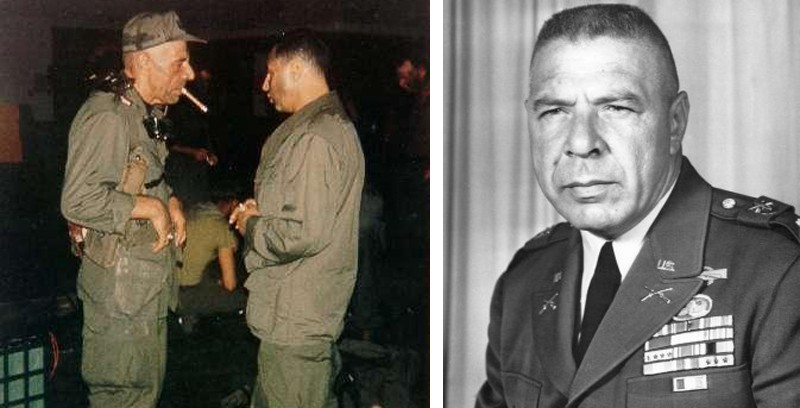
A new plan was hatched.
“One of the criteria was that these guys had to have been in live combat where they saw the man hit that they shot. Col. Simons said it’s totally different if you’re a pilot or something. He said on the ground it’s different,” Ross Perot wrote later.
The group travelled to Tehran under the guise of conducting business, gathering intelligence, and establishing contacts. Their mission was to rescue the employees from Tehran’s Qasr Prison, where they were being held. They created a plan for an Iranian EDS employee named Rashid to start a riot and lead a crowd of angry, pro-Khomeini revolutionaries to storm the prison and free thousands of political prisoners held inside.
As the revolution intensified, the streets of Tehran became increasingly dangerous, with anti-American sentiment running high. Amid this volatile backdrop, Perot’s team faced mounting challenges. A critical turning point came when the prison guards abandoned their posts, overwhelmed by the chaos of the revolution. Seizing the opportunity, the local sympathisers working with Perot's team managed to pull off the escape of Chiapparone and Gaylord.
The group navigated the dangerous streets of Tehran and managed to evade detection. In a feat of extraordinary coordination, they crossed into Turkey, 500 miles away, where the rescued employees were safely reunited with their families.
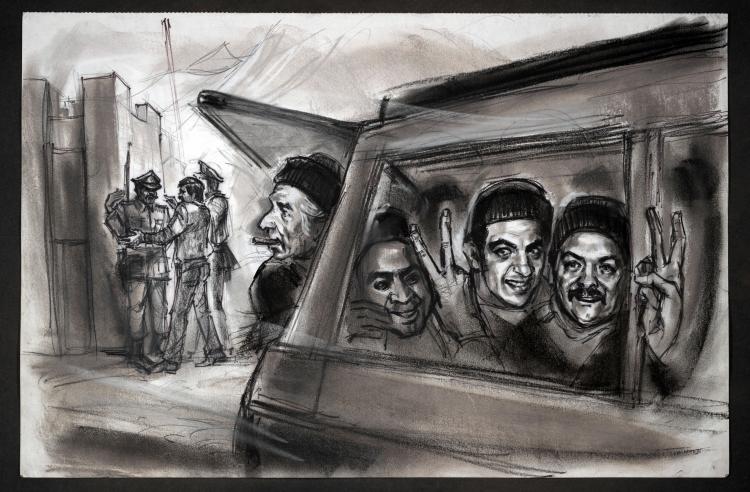
Courtroom sketch of the rescue by Ida Libby Dengrove (University of Virginia archives)
This dramatic rescue mission occurred in February 1979, several months before the American embassy hostage crisis began in November of that year. The successful operation highlighted the escalating instability in Iran during this period and the dangers faced by foreigners.
The Tehran Hostage Crisis
The tensions in Iran continued to escalate after Operation Hotfoot. On November 4, 1979, Iranian militants and student revolutionaries stormed the U.S. Embassy in Tehran, taking 66 Americans hostage. This event, known as the Tehran Hostage Crisis, lasted for 444 days and became a symbol of strained U.S.-Iran relations.
The hostages were held under dire conditions, and diplomatic efforts to secure their release proved unsuccessful. A failed military rescue mission, Operation Eagle Claw, resulted in the deaths of eight U.S. servicemen, further highlighting the crisis's severity. The hostages were finally released on January 20, 1981, after extensive negotiations mediated by Algeria. The crisis underscored the volatility of the region and the significant risks faced by Americans in Iran during this period.
Perot later recounted the events in his 1983 book, On Wings of Eagles, which was subsequently adapted into a television miniseries. The story cemented his reputation not only as a savvy businessman but also as a man of action who was willing to go to extraordinary lengths for his people.
Perot sold EDS to General Motors in 1984 for $2.5 billion. In 1992, Perot ran as an independent candidate for the U.S. presidency, winning nearly 19 percent of the popular vote. He founded the Reform Party in 1995 and ran for president again in 1996, though withdrew following attacks on his daughter. He was the first outsider to battle the DC establishment. When they went for his family, he said he was done.
In 2012, he said
"The fact is the United States is on an unsustainable course. At stake is nothing less than our position in the world, our standard of living at home and our constitutional freedoms."
Perot died of leukemia on July 9, 2019, at his home in Dallas. He was 89. I believe that he would be proud of Donald Trump and I genuinely feel he will be watching with great interest to see if his own dreams of a restored America become a reality - albeit many years on.
In 2026, Iranians know they will have to rescue themselves.
And perhaps that is the lesson for us.
In Australia, Canada, Britain - and yes, even America - many look to one figure or one politician to “save the day.” But freedom is never upheld by a single name, an election cycle, or a party logo.
It survives only when ordinary people refuse to surrender it.
BLOG COMMENTS POWERED BY DISQUS


